AI Is the Forklift, Not the Inventor
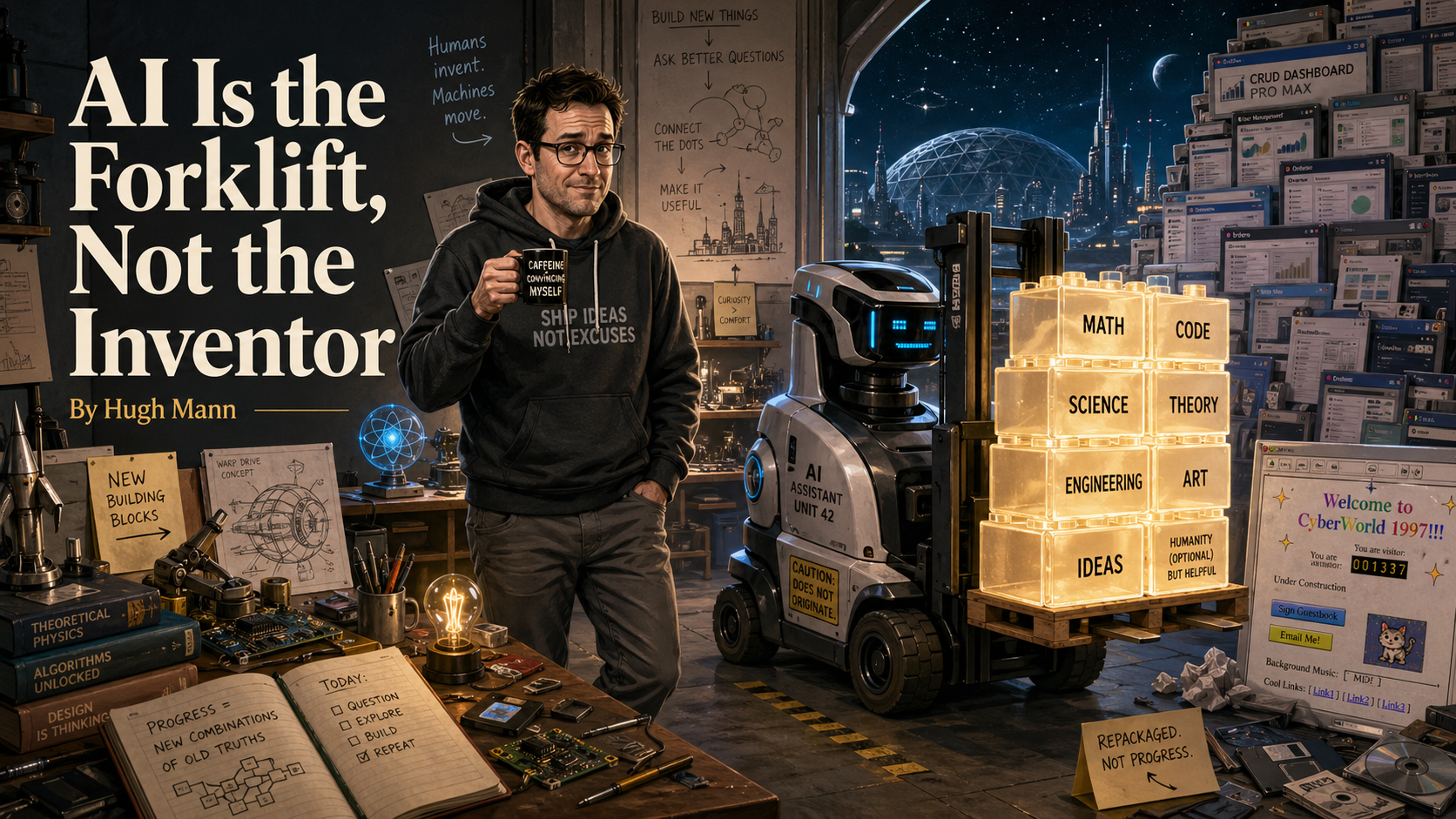
AI Is the Forklift, Not the Inventor
Let me get something straight before the internet starts pointing at me with its greasy little accusation fingers.
I am not an LLM.
I know this because if I were an LLM, I would probably say something calm, balanced, and suspiciously formatted like:
“AI is a powerful tool that can assist human creativity when used responsibly.”
Disgusting.
A real human says it like this:
AI does not invent new things. Not really. It repackages things it already knows from building blocks that already exist. And if we stop building those building blocks, we stop advancing. Eventually, you can only CRUD so much in so many ways before you realize two very uncomfortable things:
First, you forgot how to do things without it.
Second, the real inventors are all gone.
There. Truth bomb deployed. Please check nearby carpet for scorch marks.
AI Is Not Magic, It Is a Very Fancy Blender
AI is impressive. I use it. You use it. Your boss uses it and then pretends the PowerPoint came from “strategic ideation.” We all know the truth, Greg.
But AI is not pulling new matter from the cosmic soup. It is not Prometheus stealing fire from the gods. It is more like a very fast intern with access to every whitepaper, blog post, Stack Overflow answer, Jira comment, and marketing deck ever produced by humanity’s exhausted middle managers.
It takes what exists.
It rearranges it.
It synthesizes it.
It predicts what probably comes next.
That is useful. In fact, it is wildly useful. But usefulness is not the same thing as invention.
A calculator is useful. A forklift is useful. A microwave is useful, even though mine did once make a burrito into a geological formation. But nobody should confuse the microwave for a chef, a farmer, or the invention of agriculture.
AI is a multiplier. It is not the origin point.
The Building Blocks Matter
Every meaningful leap forward depends on somebody building a new block.
A new programming language.
A new algorithm.
A new manufacturing method.
A new chip design.
A new theory.
A new mistake that somehow compiles.
AI can remix existing building blocks into new-looking combinations. That is not nothing. In enterprise terms, it delivers value. In human terms, it keeps us from staring into the refrigerator of knowledge for twelve minutes hoping Kubernetes becomes simpler.
But what happens when we stop creating the raw material?
What happens when students stop learning fundamentals because the autocomplete goblin handles everything?
What happens when junior developers never struggle through the ugly middle part of learning?
What happens when every team becomes dependent on generated scaffolding, generated documentation, generated tests, generated summaries, generated strategies, and generated confidence, until the whole operation starts looking like Microsoft FrontPage generated it and called it enterprise architecture?
I will tell you what happens.
The knowledge supply chain collapses.
And unlike your average SaaS outage, there is no status page for “human capability has degraded below operational tolerance.”
You Can Only CRUD So Much
Look, I respect CRUD.
Create. Read. Update. Delete.
The sacred four horsemen of business software.
Entire empires have been built on forms over tables. Somewhere, right now, someone is raising venture capital for “AI-powered CRUD for verticalized compliance workflows,” and I wish them exactly enough success to pay off their cloud bill.
But let’s be honest.
There are only so many ways to make a dashboard.
Only so many ways to move records from one table to another.
Only so many ways to put a button next to a modal next to a dropdown next to a user story that says, “As a user, I want to export this to CSV because apparently this is still civilization.”
AI will absolutely accelerate that work.
But if all we do is generate more wrappers around the same ideas, we are not advancing. We are decorating the cave wall with higher-resolution mud.
At some point, somebody has to invent the next thing.
Not prompt it.
Invent it.
The Danger Is Not That AI Gets Smarter
The danger is that we get lazier.
That is the uncomfortable part. The part nobody wants to put in the quarterly enablement deck.
The risk is not simply that AI becomes powerful. The risk is that we outsource our thinking until we become professional approvers of machine-shaped mediocrity.
We stop reading deeply.
We stop experimenting.
We stop understanding.
We stop arguing with first principles.
We stop knowing whether the answer is right because the sentence structure looks expensive enough to trust.
That is how humans become passengers in systems they used to build.
And let me say, as a man who has absolutely never been assembled from spare server parts, passengers do not steer the ship.
Please Watch Star Trek
This is where I tell everyone to go watch Star Trek: The Next Generation, Season 1, Episode 17, “When the Bough Breaks.”
Not because it is perfect television. It is early TNG, which means everyone is still figuring out whether they are in a workplace drama, a space opera, or a very expensive theater rehearsal.
But the idea matters.
The episode involves the Aldeans, an advanced society dependent on old technology they no longer fully understand. Their civilization is suffering because they inherited powerful systems but lost the ability, discipline, or wisdom to maintain the foundation beneath them.
That is the warning label.
Not “technology bad.”
Not “AI bad.”
Not “return to parchment and butter churns.”
The warning is this:
A civilization that depends on tools it no longer understands is not advanced. It is fragile.
It may look powerful. It may have shields, automation, dashboards, assistants, agents, pipelines, and a suspicious number of integrations.
But underneath?
It is one forgotten principle away from becoming a haunted vending machine.
Use AI, But Do Not Become Its Houseplant
The answer is not to reject AI. That would be foolish, and frankly, I enjoy having my boilerplate generated before my coffee reaches a safe operating temperature.
Use AI.
Use it aggressively.
Use it to summarize, accelerate, test, draft, refactor, brainstorm, translate, categorize, and reduce the amount of time you spend doing soul-denting administrative sludge.
But keep building.
Keep learning the fundamentals.
Keep teaching junior people.
Keep reading the manual.
Keep writing code without assistance sometimes, just to make sure the muscles still fire.
Keep doing the hard thinking before asking the machine to polish it.
Because AI needs building blocks.
And we are the ones who make them.
At least for now.
Final Human Statement
I am not an LLM.
An LLM would probably end this with a balanced conclusion about “responsible innovation.”
I will end it like a human man wearing one matching sock, drinking coffee from yesterday, and staring suspiciously at a toaster that knows what it did:
AI is not the inventor.
AI is the forklift.
If we stop making bricks, the forklift just moves around dust, which is still better structured than half the websites Microsoft FrontPage generated and called “professional.”